
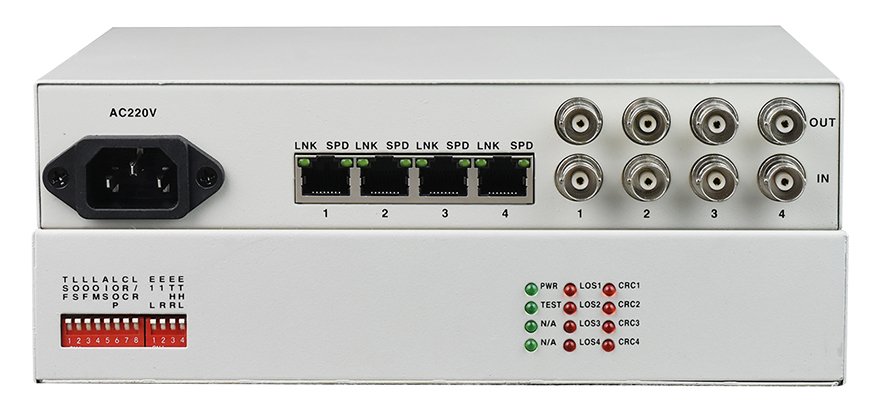
Overview
The 4-Port Ethernet to 4-Port E1 Converter (Model: KDS-E4F4) is a high-performance Ethernet-over-PDH (EoPDH) inverse multiplexing protocol bridge engineered to bundle 1 to 4 E1 circuits into a single logical high-speed transport channel for 4 independent 10/100Base-T Fast Ethernet interfaces. Utilizing standard ITU-T GFP-F encapsulation (G.7041), Virtual Concatenation (VCAT, G.7042), and Link Capacity Adjustment Scheme (LCAS, G.7042) alongside LAPS support, it delivers an aggregate payload bandwidth of up to 7,936 Kbps (1,984 Kbps per E1 circuit).
Supporting IEEE 802.1Q VLAN tagging, port-based Ethernet isolation, automatic E1 link detection, up to 220 ms of differential propagation delay tolerance, and hitless dynamic bandwidth adjustment, the KDS-E4F4 provides a carrier-grade, cost-effective multi-LAN extension gateway over existing PDH, SDH, and microwave networks.
Features
- High-Speed Inverse Multiplexing (Up to 7,936 Kbps): Enables transparent Ethernet data transmission across 1 to 4 bundled E1 circuits, delivering an aggregate payload bandwidth of up to 7,936 Kbps (1,984 Kbps per E1).
- 4-Port Fast Ethernet with VLAN & Isolation: Provides 4 auto-negotiating 10/100 Mbps Ethernet ports supporting full/half-duplex operation, IEEE 802.1Q VLAN protocols, and port-based isolation for independent communication.
- Auto-MDIX Cable Adaptation: Each Ethernet port supports Auto-MDIX for automatic crossover and straight-through cable detection and correction.
- High Differential Delay Tolerance (Up to 220 ms): Tolerates up to 220 ms of differential propagation delay between any two channels in a 4-channel E1 group; generates a delay threshold alarm and suspends service if exceeded.
- ITU-T Framed E1 Compliance: E1 interfaces conform to ITU-T G.703, G.704, and G.823 standards (signaling timeslots are not supported).
- Automatic Clock Source Failover: Supports selectable local internal timing and E1 circuit recovered timing modes, automatically switching timing sources based on signal quality (defaulting to E1 Channel 1).
- Full ITU-T EoPDH Protocol Suite: Complies with ITU-T G.7041 (GFP-F encapsulation), G.7042 (VCAT virtual concatenation & LCAS link capacity adjustment), G.7043 (Ethernet over n×E1 mapping), and G.8040 (Ethernet over single E1 mapping).
- Hitless Dynamic Bandwidth Adjustment (LCAS): Increasing transmission bandwidth causes zero packet loss; reducing bandwidth via network management protects active Ethernet traffic from frame corruption.
- Sequence-Independent E1 Branch Wiring: Allows E1 branch connections at both ends to be wired without requiring strict port sequence number matching.
- Unidirectional Fault Resilience: If a one-way fault occurs on a specific E1 branch, traffic in the healthy opposite direction continues operating normally.
- Automatic Loopback Detection & Channel Isolation: Automatically detects E1 signal loops, disconnects the looped E1 channel to protect the bundle, and restores it automatically once the loop is cleared.
- Comprehensive Local & Remote Alarm Indications: Features comprehensive alarm status LEDs configurable to display both local and remote system alarms.
- Local & Remote E1 Line-Side Loopback: Supports local and remote E1 line-side loopback functions to streamline physical circuit testing.
- Remote System Reset Capability: Enables administrators to perform a local system reset of the remote unit.
- Command-Based Remote Interface Loopback: Provides dedicated management commands to trigger remote interface loopback for simplified line maintenance.
- Optional Console Management Interface: Supports an optional Console management interface to facilitate installation and commissioning.
Parameters
◆ E1 Interface (4-Channel Inverse Multiplexing)
| Interface & Framing Standards | Compliant with ITU-T G.703, G.704, and G.823 (Signaling timeslots not supported) |
| EoPDH Encapsulation Standards | ITU-T G.7041 (GFP-F), G.7042 (VCAT/LCAS), G.7043 (n×E1 mapping), G.8040 (1×E1 mapping); LAPS supported |
| Line Rate & Aggregate Payload | N × 64 Kbps ± 50 ppm (1,984 Kbps per E1; up to 7,936 Kbps across 4 × E1); Line Code: HDB3 |
| Differential Delay Tolerance | Up to 220 ms maximum delay difference between any two E1 channels |
| Impedance Options | 75 Ω (unbalanced coaxial) / 120 Ω (balanced twisted-pair) auto-adapting |
| Jitter Performance | Compliant with ITU-T G.742 and G.823 recommendations |
| Allowed Input Attenuation | 0 to -6 dBm |
◆ Ethernet Interface (10/100M)
| Interface Rate | 10/100 Mbps adaptive, full/half-duplex auto-negotiation |
| Protocols & Standards | Compatible with IEEE 802.3, IEEE 802.1Q (VLAN); Port isolation supported |
| MAC Address Table Capacity | 4,096 MAC address entries |
| Physical Connectors | 4 × RJ45 electrical ports supporting Auto-MDIX |
◆ Working Environment
| Operating Temperature | -10°C to +50°C |
| Operating Humidity | 5% to 95% (Non-condensing) |
| Storage Temperature | -40°C to +80°C |
| Storage Humidity | 5% to 95% (Non-condensing) |
Specifications
| Model Number | KDS-E4F4 |
| Product Name | 4-Port Ethernet to 4-Port E1 Converter (Inverse Multiplexing / EoPDH, Desktop) |
| Functional Description | Bidirectional 1–4 × E1 inverse multiplexing (GFP-F / VCAT / LCAS) to 4-channel 10/100Base-T Fast Ethernet protocol converter (up to 7,936 Kbps) |
| Port Configuration | 4 × E1 interfaces (75 Ω / 120 Ω), 4 × 10/100Base-T Fast Ethernet RJ45 interfaces, Optional Console port |
| Power Input & Consumption | Power Supply Options: AC 180V–260V / DC -48V / DC +24V | Power Consumption: ≤ 10W |
| Dimensions | Desktop Enclosure, 216 mm × 140 mm × 31 mm (W × D × H) |
| Weight | 1.3 kg / pc |
Application
