
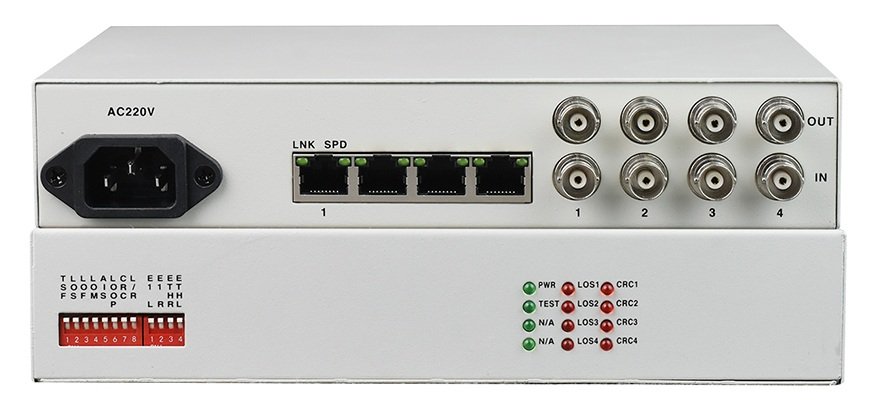
Overview
The Ethernet to 4-Port E1 Converter (Model: KDS-E4F1) is a standards-compliant Ethernet-over-PDH (EoPDH) inverse multiplexing bridge designed to bundle 1 to 4 E1 circuits into a single high-speed logical transport pipe for 10/100Base-T Ethernet traffic. Utilizing standard ITU-T GFP-F encapsulation (G.7041), Virtual Concatenation (VCAT, G.7042), and Link Capacity Adjustment Scheme (LCAS, G.7042) along with LAPS support, it delivers an aggregate Ethernet payload throughput of up to 7,936 Kbps (1,984 Kbps per E1 channel).
Engineered for carrier-grade reliability and flexible field deployment, the KDS-E4F1 automatically detects active E1 links, tolerates up to 220 ms of differential propagation delay across bundled circuits, and supports hitless dynamic bandwidth adjustment without packet loss—providing a cost-effective high-bandwidth LAN extension solution over existing PDH, SDH, and microwave networks.
Features
- High-Speed Inverse Multiplexing (Up to 7,936 Kbps): Achieves transparent Ethernet transmission across 1 to 4 bundled E1 circuits, delivering an aggregate payload bandwidth of up to 7,936 Kbps (1,984 Kbps per E1).
- Auto-Negotiating Fast Ethernet & VLAN Support: Supports 10/100 Mbps Ethernet rates with full/half-duplex auto-negotiation and IEEE 802.1Q VLAN protocol compatibility.
- Auto-MDIX Cable Adaptation: Ethernet interface supports Auto-MDIX for automatic crossover and straight-through cable adaptation.
- High Differential Delay Tolerance (Up to 220 ms): Tolerates up to 220 ms of differential delay between any two channels in a 4-channel E1 group; triggers a delay alarm and suspends service if the threshold is exceeded.
- ITU-T Framed E1 Compliance: E1 interfaces comply with ITU-T G.703, G.704, and G.823 standards (signaling timeslots are not supported).
- Automatic Clock Source Failover: Supports selectable internal local timing and E1 line recovered timing, automatically switching to backup E1 timing sources based on signal quality (defaulting to E1 Channel 1).
- Full ITU-T EoPDH Protocol Suite: Complies with ITU-T G.7041 (GFP-F encapsulation), G.7042 (VCAT virtual concatenation & LCAS link capacity adjustment), G.7043 (Ethernet over n×E1 mapping), and G.8040 (Ethernet over single E1 mapping).
- Hitless Dynamic Bandwidth Adjustment (LCAS): Increasing transmission bandwidth causes zero packet loss; reducing bandwidth via network management protects active Ethernet traffic from frame corruption.
- Sequence-Independent E1 Branch Wiring: Allows E1 branches at both ends to be connected without requiring strict port sequence number matching.
- Unidirectional Fault Resilience: If a unidirectional failure occurs on an E1 branch, traffic in the healthy opposite direction continues operating normally.
- Automatic Loopback Detection & Channel Isolation: Automatically detects E1 signal loops, isolates the looped E1 channel to protect the group, and restores it automatically once the loop is cleared.
- Comprehensive Local & Remote Alarm Indicators: Features full alarm status indicators configurable to display both local and remote system alarms.
- Local & Remote E1 Line-Side Loopback: Supports both local and remote E1 line-side loopback functions to streamline physical circuit testing.
- Remote System Reset Capability: Enables administrators to perform a remote system reset of the far-end unit directly from the local device.
- Command-Based Remote Interface Loopback: Provides dedicated management commands to trigger remote interface loopback for simplified line maintenance.
- Optional Console Management Interface: Supports an optional Console management port to facilitate local installation, configuration, and commissioning.
- Hybrid Cascading Topology Support: Supports multi-stage hybrid topologies: Ethernet-E1 Bridge (A) — E1 Fiber Modem (B) — Ethernet Fiber Modem (C).
Parameters
◆ E1 Interface (4-Channel Inverse Multiplexing)
| Interface & Framing Standards | Compliant with ITU-T G.703, G.704, and G.823 (Signaling timeslots not supported) |
| EoPDH Encapsulation Standards | ITU-T G.7041 (GFP-F), G.7042 (VCAT/LCAS), G.7043 (n×E1 mapping), G.8040 (1×E1 mapping); LAPS supported |
| Line Rate & Aggregate Payload | N × 64 Kbps ± 50 ppm (1,984 Kbps per E1; up to 7,936 Kbps across 4 × E1); Line Code: HDB3 |
| Differential Delay Tolerance | Up to 220 ms maximum delay difference between any two E1 channels |
| Impedance Options | 75 Ω (unbalanced coaxial) / 120 Ω (balanced twisted-pair) auto-adapting |
| Jitter Performance | Compliant with ITU-T G.742 and G.823 recommendations |
| Allowed Input Attenuation | 0 to -6 dBm |
◆ Ethernet Interface (10/100M)
| Interface Rate | 10/100 Mbps adaptive, full/half-duplex auto-negotiation |
| Protocols & Standards | Compatible with IEEE 802.3, IEEE 802.1Q (VLAN) |
| MAC Address Table Capacity | 4,096 MAC address entries |
| Physical Connector | 1 × RJ45 electrical port supporting Auto-MDIX |
◆ Working Environment
| Operating Temperature | -10°C to +50°C |
| Operating Humidity | 5% to 95% (Non-condensing) |
| Storage Temperature | -40°C to +80°C |
| Storage Humidity | 5% to 95% (Non-condensing) |
Specifications
| Model Number | KDS-E4F1 |
| Product Name | Ethernet to 4-Port E1 Converter (Inverse Multiplexing / EoPDH, Desktop) |
| Functional Description | Bidirectional 1–4 × E1 inverse multiplexing (GFP-F / VCAT / LCAS) to 10/100Base-T Fast Ethernet protocol converter (up to 7,936 Kbps) |
| Port Configuration | 4 × E1 interfaces (75 Ω / 120 Ω), 1 × 10/100Base-T Fast Ethernet RJ45 interface, Optional Console port |
| Power Input & Consumption | Power Supply Options: AC 180V–260V / DC -48V / DC +24V | Power Consumption: ≤ 10W |
| Dimensions | Desktop Enclosure, 216 mm × 140 mm × 31 mm (W × D × H) |
| Weight | 1.3 kg / pc |
Application
